

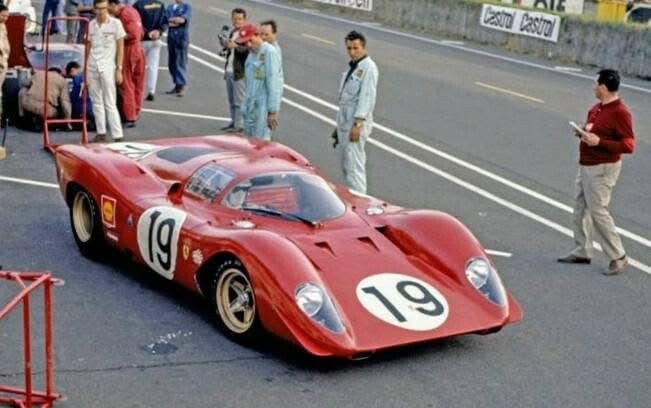

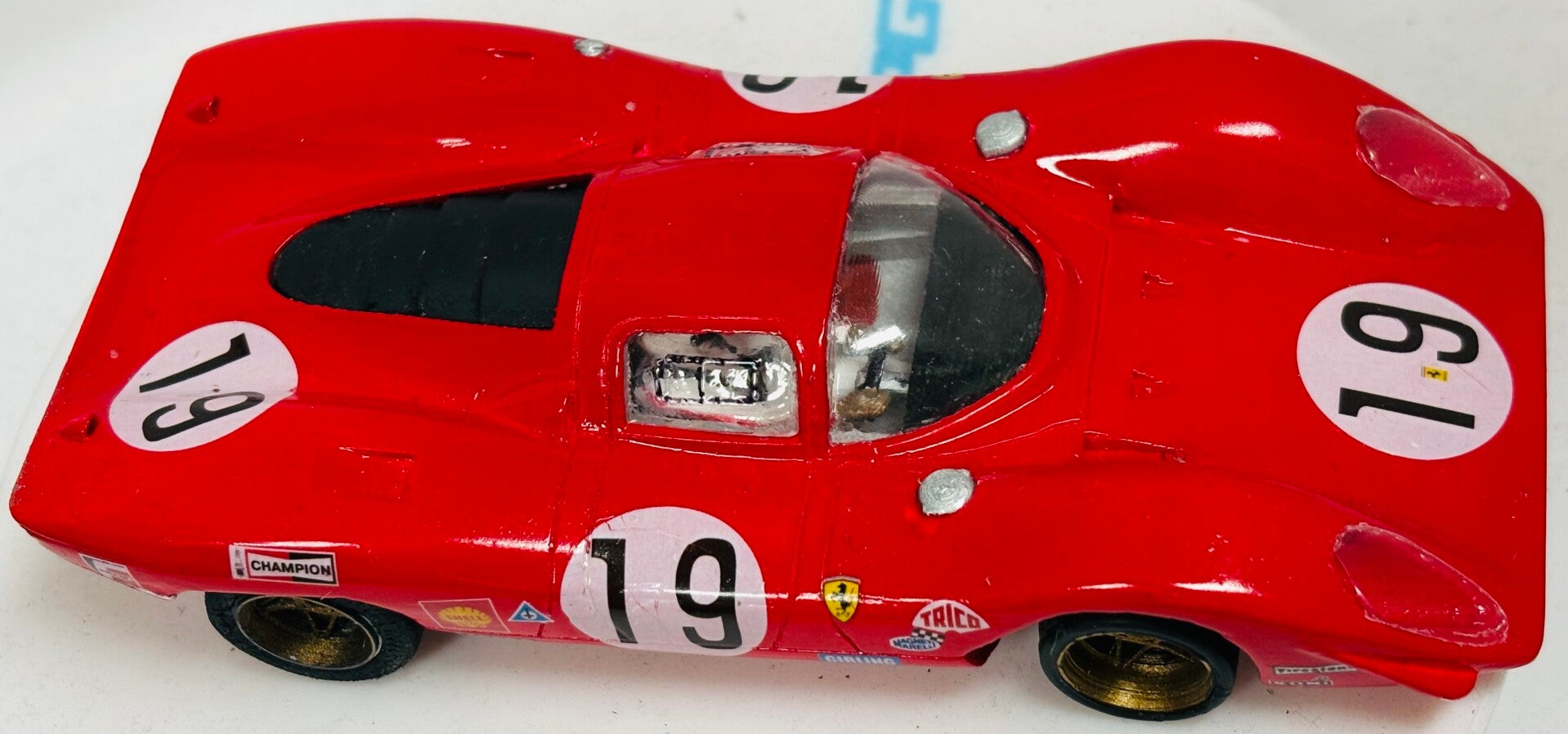
When thinking about a new car to make for our Le Mans Classic class, I was browsing through photos and references when I came upon the photo above of the Ferrari 312P #19 coupe from 1969. It's fair to say that I was smitten. So I concentrated my search for references on this car. But, inevitably, that search also brought up many photos of the open version. So, early in the development, I decided to make both bodies to fit this chassis as the dimensions of both are identical. And I loved the look of them both.
To give a bit of the back story, I'm going to selectively quote from the excellent supercarnostalgia.com website:
After a self-imposed year in exile, Scuderia Ferrari returned to the World Sportscar Championship for 1969 with the all-new 312 P.
Ferrari’s absence from the 1968 campaign had come about as a result of the FIA’s new three-litre engine limit for Group 6 Prototypes which was a reaction to the unprecedented speed of machinery like the Ford MkIV and Ferrari P4.
The three-litre rule for 1968 was announced a day after the 1967 Le Mans 24 Hours, but was done without any manufacturer consultation. It meant Group 6 Prototypes with engines over three-litres were made obsolete. Enzo Ferrari felt the decision was blatant favouritism towards Porsche and announced his team would play no part in the 1968 series.
Instead, Ferrari went Group 7 Can-Am racing.
However, by the summer of 1968, Enzo Ferrari had decided he wanted to re-enter the World Sportscar Championship for 1969. As a result, a brand new three-litre Group 6 Prototype was conceived: the 312 P.
As had been the case in 1968, 1969 would see three-litre Group 6 Prototypes race alongside Group 4 Sports cars. Whereas Group 6 vehicles had a three-litre engine limit but no minimum production requirement, Group 4 machinery could run engines of up to five-litres but 25 cars had to be built to qualify. The 25 car figure had been reduced from 50 in an attempt to stimulate entries for 1969.
Against expectations, it had been the Group 4 Gulf Oil-backed Ford GT40s of John Wyer Automotive Engineering that won the 1968 championship. The British team pipped Porsche to the title by three points.
For 1969 though, the fast developing three-litre Group 6 Prototypes were expected to dominate. In addition to Porsche and Ferrari, works cars from Matra, Alfa Romeo, Mirage and Alpine would arrive during the course of the season.
The 312 P was unveiled in December 1968 during a press conference at the Hotel Real Fini in Modena.
Meanwhile, unbeknown to the other manufacturers, Porsche had a surprise up their sleeve; as a result of the FIA’s reduced 25 unit homologation requirement, the Germans were preparing a brand new five-litre car that was effectively an out-and-out Prototype for the Group 4 class…
Ferrari built three copies of the 312 P on chassis 0868, 0870 and 0872.
0869 started life as a Spyder. It did three early season races but on its final outing incurred accident damage that ruled it out of any further competitive action. It was subsequently used as the basis for a Pininfarina design concept dubbed the Ferrari 512 S Speciale that was displayed at the Turin Motor Show in October 1969.
0870 was also initially built as a Spyder. It did four races in this configuration and was then converted to Coupe trim for the 1969 Le Mans 24 Hours, after which it was sold to Ferrari’s US distributor, Luigi Chinetti. 0870 went on to make one more appearance in 1969 followed by a trio of outings in 1970.
0872 was the only 312 P originally built as a Coupe. It was assembled in time for the 1969 Le Mans 24 Hours, after which it too was sold to Luigi Chinetti who ran it in three races during 1970.
Scuderia Ferrari contested six World Sportscar Championship races with the 312 P in 1969: the Sebring 12 Hours, Brands Hatch 6 Hours, Monza 1000km, Spa 1000km, Nurburgring 1000km and Le Mans 24 Hours.
At Sebring, Mario Andretti promisingly put the new car on pole with a record lap time. Chris Amon then had a bad start in the race, but the 312 P proved sufficiently quick that it should have won. Unfortunately, a progressively down-on-power engine that began belching smoke along with a long stop for faulty lights meant Andretti / Amon eventually had to settle for second.
Ferrari then ran the same car at the Le Mans test weekend where Porsche debuted the shatteringly fast new 917. The 312 P ended up fifth fastest overall and third in class.
At the Brands Hatch 6 Hours Amon / Rodriguez qualified second but finished fourth as a result of a puncture and a troublesome accelerator pedal cable.
Two cars were then on hand for the Monza 1000km, but neither Mario Andretti / Chris Amon (who started from pole) or Pedro Rodriguez / Peter Schetty made it to the chequered flag owing to crankshaft failure and a major accident respectively.
Following the big Monza crash, Scuderia Ferrari were back down to just one 312 P for the 1000km races at Spa and the Nurburgring. In Belgium, Pedro Rodriguez / David Piper started fourth and finished second while in Germany, Amon / Rodriguez posted a DNF owing to electrical trouble having started second.
The final works outing for the 312 P came at the Le Mans 24 Hours where the sole remaining 312 P ran alongside a brand new example, both of which wore Coupe as opposed to Spyder bodies. Piper / Rodriguez started fifth and Amon / Schetty seventh but the race ended with a disappointing double DNF.
Chris Amon was caught up in John Woolfe’s fatal opening lap accident and incurred fire damage while the sister car was eventually retired as a consequence of its ever rising oil consumption.
After Le Mans, both cars were sold to Luigi Chinetti following FIAT’s acquisition of a 50% stake in Automobili Ferrari for $11m. The deal was finalised on June 21st. It saw Enzo Ferrari maintain control of the marque’s racing operations while FIAT took over the passenger car division.
Flush with cash, Enzo Ferrari immediately gave the go ahead for a new five-litre car to challenge the Porsche 917 in the Sports car class: the Ferrari 512 S.
Chinetti went on to run one 312 P at the Bridgehampton Can-Am race during the autumn where Pedro Rodriguez claimed fifth having started eleventh.
In 1970, Chinetti’s NART outfit campaigned his brace of cars at the Daytona 24 Hours (fourth and fifth overall for a class one-two), the Sebring 12 Hours (sixth overall, fourth in class and a DNF) and the Le Mans 24 Hours (where one 312 P posted a DNF and the other served as a spare). End of quote
So, from the above, you can see that the 312P wasn't particularly successful on the track but, in my opinion, it was one of the most beautiful cars of it's era. And it has the characteristics that I look for in a slot car... low and wide.
I initially designed pods to take either a short can or a slimline motor (sidewinder). I found that a Predator 25K Ball Bearing short can was the better setup. But then I received my first batch of PGR 25K ball bearing FK-130 motors so I just had to make a new pod and try it. Hands down better! So there are now three motor option for these two cars!
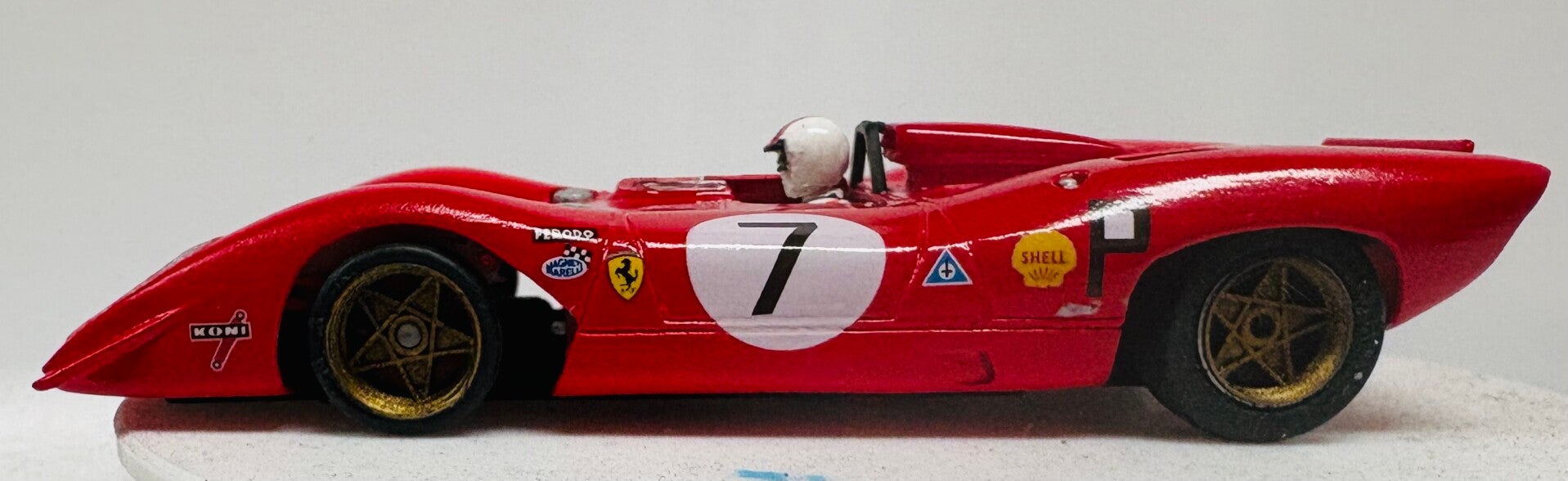
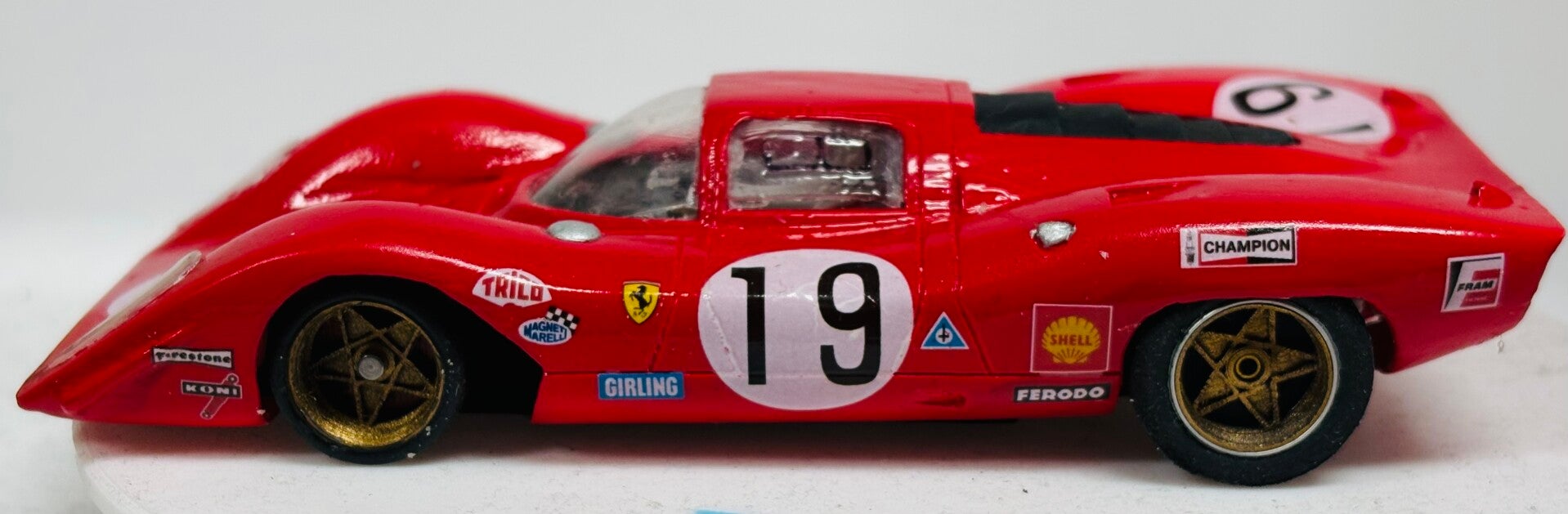
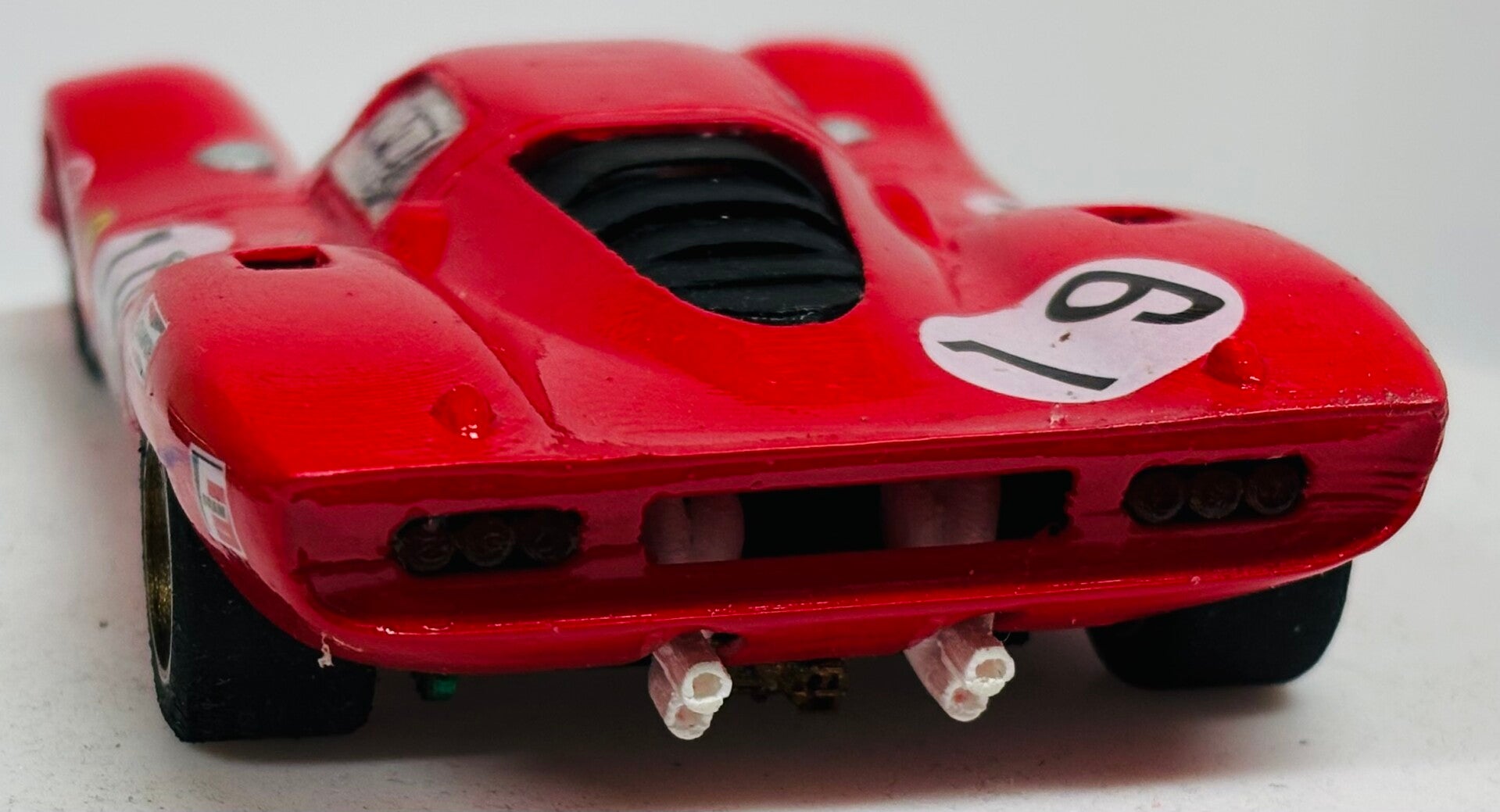
Here are my two new babies. I hope you like them.
Click on the photos to expand (and see my paint defects)
Click on this button to purchase one (or two) of these kits. Click and scroll the "Choose your model"dropdown list.


And here are a couple of chassis photos....


I'd really like to know if there is, in fact, an audience for my irregular ramblings.
If you would like to receive notification when I post a new blog, please add a comment below and I'll email to let you know.
Add comment
Comments